Tuesday, November 27, 2012
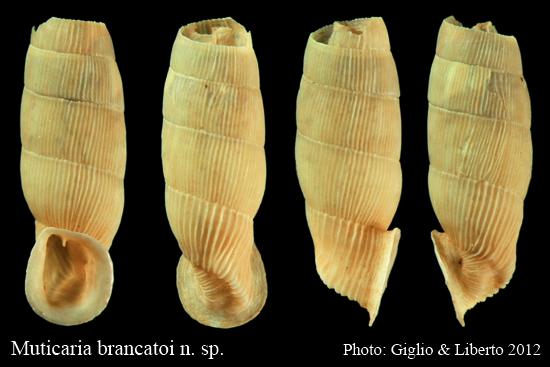
New Sicilian landsnails
Sunday, January 9, 2011
Species spotlight III
- long and narrow shell
- shell top not broken
- ribbed
- more than two incomplete ribs on last whorl
- shell tapers down near opening
Tuesday, January 4, 2011
A walk around the Colosseum
In 1643, far before the advent of Linnaean taxonomy, a gent by the name of Domenico Panaroli decided to publish an inventory of the plants found inside the Colosseum after noticing several exotic (mainly North African) species inside and around it, resulting in the tome Plantarum Amphytheatralium Catalogus. Nowadays, the list of species from the Colosseum has grown to 684 species of plants (Caneva, 2003).
Caneva, G., 2003. The Colosseum's use and state of abandonment as analysed through its flora. International Biodeterioration & Biodegradation, 51: 211-219.
Panaroli, D., 1643. Jatrologismi sive medicae observationes quibus additus est in fine Plantarum Amphytheatralium Catalogus. Typis Dominici Marciani, Rome.
Friday, June 18, 2010
Lampedusa... from Lampedusa

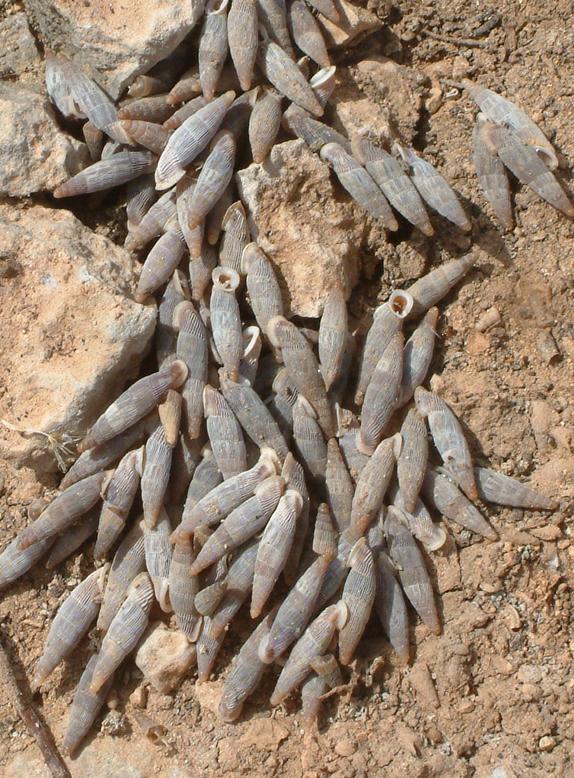
Photograph of a typical aggregation of the snails taken in 2005 by Arie W. Janssen.
Wednesday, March 17, 2010
New project uploaded

Maltese Endemic Landsnails
Virtually all photographs included are appearing on the web for the first time.
The website expires this year, so I will upload the content here as soon as that occurs.
Wednesday, February 24, 2010
Variations on a theme, Part II
The entity endemic to the Maltese Islands, namely Muticaria macrostoma (Cantraine, 1835) has, since the Pleistocene, diverged into local and very characteristic (though hybridizing) varieties, two of which are extremely limited in distribution. The typical forms are shown below.
I would like to thank Mr. He Jing for the excellent photographs and also for the permission to use them.


References:
Beckmann, K.-H., 1990. Beiträge zur Kenntnis der Landmolluskenfauna Siziliens mit der Beschreibung von Muticaria neuteboomi spec. nov. (Gastropoda: Pulmonata: Clausiliidae). Basteria, 54 (1/3): 75-85.
Giusti F., Manganelli G. & Schembri P.J., 1995. The non-marine molluscs of the Maltese Islands. Monografie Museo Regionale di Scienze Naturali, Torino, 15: 1-608.
Nordsieck, H., 2007. Worldwide door snails (Clausiliidae), recent and fossil. Hackenheim: Conchbooks, 214 pp.
Schembri, P.J. & Sultana, J. (eds.), 1989. Red Data Book for the Maltese Islands. Malta: Department of Information, pp. i-viii + 1-142 + 8 pl.
Sunday, June 7, 2009
Part III: The Biogeography of the Maltese Islands
The shelled slug Testacella riedeli is the only terrestrial gastropod showing strong affinities with North African fauna (Giusti et al., 1995), however, this group of fauna is also derived from South European forms, which survived on landmasses fragmenting from South Europe and colliding into North Africa in the Early Miocene. The majority of animals and plants are closely related to Sicilian organisms, with fossils excluding the possibility that these were imported through human agency.
As an archipelago, Malta probably started to become exposed during the Messinian Salinity Crisis in the late Miocene. The virtual absence of macrofossils in some areas of the UCL suggests a supralittoral (or intertidal) landmass (Pedley et al., 1976). Subsequently, the archipelago was probably submerged and exposed several times with fluctuating sea levels and tectonic activity up to the Pleistocene. Pliocene deposits are absent on the Maltese Islands, suggesting aerial erosion.
The earliest suggestions for links with Sicily can be seen in the Quaternary deposits of Ghar Dalam, which contain fauna similar to that in mainland Europe such as species of Ursus, Palaeoloxodon, Cervus, Hippopotamus and other large mammals. Subsequent isolation of Malta can be deduced by the progressive dwarfing of some of these mammals in a process known as insular dwarfism (Zammit-Maempel, 1989) and the reverse process (insular gigantism) in the lizard Lacerta siculimelitensis (Boehme & Zammit-Maempel, 1982).
More information on the origin of the Maltese Islands is evident by looking at the clausiliid snails (Thake, 1985). Lampedusa originated from a Sicilian ancestor and invaded the land presently containing Malta and Lampedusa island in the Late Miocene. This is supprted by the fact that the island of Lampedusa harbours a species similar to the Maltese Lampedusa, namely L. lopadusae. On isolation of the islands during the Pliocene, the Lampedusa sp. in Malta differentiated into L. imitatrix which later also gave rise to L. melitensis.
Subsequently, either the sea-level fell again or the landmass rose so that Malta became connected to Sicily again. The Lampedusa-like ancestor on Sicily had meanwhile evolved into Muticaria macrostoma, which took the opportunity to invade the islands again. Being more competitive than Lampedusa sp., it managed to take over the areas occupied by Lampedusa, which it pushed to a restricted area on the southern coast of Malta. Interestingly, the island of Filfla was probably already detached from the Maltese mainland since Muticaria does not occur there, but a form of L. imitatrix thrives. Muticaria evolved into local forms following subsequent isolation of the Maltese mainland.
Plants are also mostly allied with South Europe forms, for example, Iris sicula and Ophrys oxyrrhyncos are endemic to Malta and Sicily. A relatively weaker North African link is also shown in plants such as Crucianella rupestris and Hypericum aegypticum.
References:
Boehme, W. & Zammit Maempel, G. (1982) Lacerta siculimelitensis sp. n. (Sauria: Lacertidae), a giant lizard from the Late Pleistocene of Malta. Amphibia-Reptilia, 3 (2-3), pp. 257-268.
Giusti, F., Manganelli, G. & Schembri, P. J. (1995). The non-marine molluscs of the Maltese Islands. pp. 1-608, Torino.
Pedley, H. M., House, M. R., & Waugh, B. (1976), The Geology of Malta and Gozo. Proceedings of the Geologists’ Association, 87, pp. 325-341.
Thake, M. A. (1985). The biogeography of the Maltese Islands, illustrated by the Clausiliidae. Journal of Biogeography, 12, pp. 269-287.
Zammit Maempel, G. (1977). An Outline of Maltese Geology. pp. 1-44, Progress Press, Malta.
Zammit Maempel, G. (1989). Ghar Dalam – Cave and Deposits. pp. 1-74, PEG, Malta.
Part II: The endemic species of the Maltese Islands
Such species, apart from being unique, are biologically important because they show reproductive isolation and speciation at work. The lizard Podarcis filfolensis is perhaps the best known example of this, having evolved into different sub-species on most of the islands of the archipelago. It is the only endemic vertebrate in addition to the shrew Crocidura sicula calypso.
Terrestrial molluscs are a type of animal that evolves relatively quickly, in fact, 14% of the endemic animals are gastropods. Of these, the most interesting are the Hygromiidae and the Clausiliidae, which give clues as regards the isolation of the Maltese Archipelago from the surrounding land. The endemic snails Cernuella caruanae and Trochoidea spratti are relatively widespread, but the rarest gastropod is also an endemic – Lampedusa melitensis is a clausiliid whose population only consists of a few hundred individuals in a restricted ‘rdum’ area at Dingli. A sister species is Lampedusa imitatrix which is found further to the west along the southern coast of Malta. The last endemic clausiliid is Muticaria macrostoma, a taxon previously thought to consist of four different species, but these are anatomically indistinguishable (Giusti et al., 1995). The forms mamotica and scalaris are extremely restricted and therefore vulnerable. The forms macrostoma and oscitans, on the other hand, are frequent and one form prevails according to the geographical location. The southern coast of Malta (including Dingli) harbours the oscitans form.
81% of the endemic animal species are arthropods. These include the beautiful Maltese race of the butterfly Papilio machaon as well as the well-known freshwater crab Potamon fluviatile.
Endemic plants of the Maltese Islands are usually relicts from larger populations in a time when Malta was joined to Europe by a land bridge, for this reason they are called palaeoendemics. These are mostly restricted to rupestral habitats where they have competitively excluded other plants by tolerating harsh conditions such as high salinity. At Dingli, one can witness the species Darniella melitensis, Jasonia bocconei, and Palaeocyanus crassifolius, which is also Malta’s national plant. Cremnophyton lanfrancoi and Allium lojaconoi, a wild garlic that forms part of a cluster of similar species in central Mediterranean islands, are other palaeoendemics. Other endemic plants with more recent evolution are the orchid Anacamptis urvilleana and two species of Limonium, for this reason, they are referred to as neoendemics.