Showing posts with label geology. Show all posts

Wednesday, January 11, 2012

Steno on Google

The 374th anniversary of birth of the 'father of geology' Nicolaus Stensen, better known by his latinized name Nicolas Steno, is commemorated today on Google with a doodle showing a stylized stratigraphic section similar to what he may have encountered to come up with his conclusions.


Steno was featured on this blog together with his contemporary Agostino Scilla in a post from 2010.

Wednesday, August 3, 2011

Above the clouds of El Teide

The third largest volcano on earth (according to some sources, but not to others - it depends on how you go about measuring volcanoes) is found off West Africa, on Tenerife.

To see the majestic peak of this volcano, El Teide, one must traverse a height of about two kilometres of pine forest, dominated by the endemic Canarian pine Pinus canariensis C.Sm. This pine has developed an extraordinary way of utilizing the water available in the mist enveloping these forests - its leaves are tall and thin, allowing condensation of water droplets on their large surface area. This water trickles down, dropping into the soil and providing roots with much-needed hydration.

Pinus canariensis C.Sm., 2.5km up east El Teide

In some places, violent storms some years back have ripped the trees down, the trunks of which together with the flowing clouds produce an eerie atmosphere reminiscent of any horror film worth its salt:

wind-battered pine forest, c. 2km up east El Teide

After the ascent of about another kilometre one can see the forest spread below and a wide swathe of cloud enveloping it:

About 3km up El Teide, the volcano in the background
Coming up next: some local flora.

Saturday, January 22, 2011

Stone spiral

Cypraea sp.
Chattian, Oligocene
Lower Globigerina Limestone, Birżebbuġa, Malta

Monday, December 20, 2010

Scales in stone

From the 12th of this December to the 16th of January 2011, Heritage Malta is organizing an exhibition on fossil fish from the Maltese Islands at the National Museum of Natural History (NMNH) in Mdina.


Such remains are of high importance, both palaeontologically and historically, being featured in several scientific publications including palaeoecological studies and new taxonomic descriptions. Most are also extremely rare, with fragile bones that do not fossilize easily.

To whet appetites, here's a taster of what the NMNH collection of fossil fish includes:

Stereodon melitensis Owen, 1864

Myliobates sp.

Holocentrum melitense Woodward, 1887

Thursday, August 12, 2010

Dissertation - A student’s guide to the geology of the Maltese Islands

The citation and abstract to my B. Ed. (Hons) dissertation have been added to the links on the right-hand side of this blog. The page can also be accessed through here.

Wednesday, July 7, 2010

A pirate's cave


The 12th century legend goes that a Turkish pirate by the name of Ħassan, madly in love with a beautiful Maltese girl, abducted her and took her to live with him in a cave in the southern cliffs of Malta. The villagers soon realized this and were immediately off to rescue the girl, then give the Turk the punishment he deserved. Upon hearing their shouts, the defiant Ħassan pushed the girl down the cliffs to her death, and leapt after her before anyone could catch him.


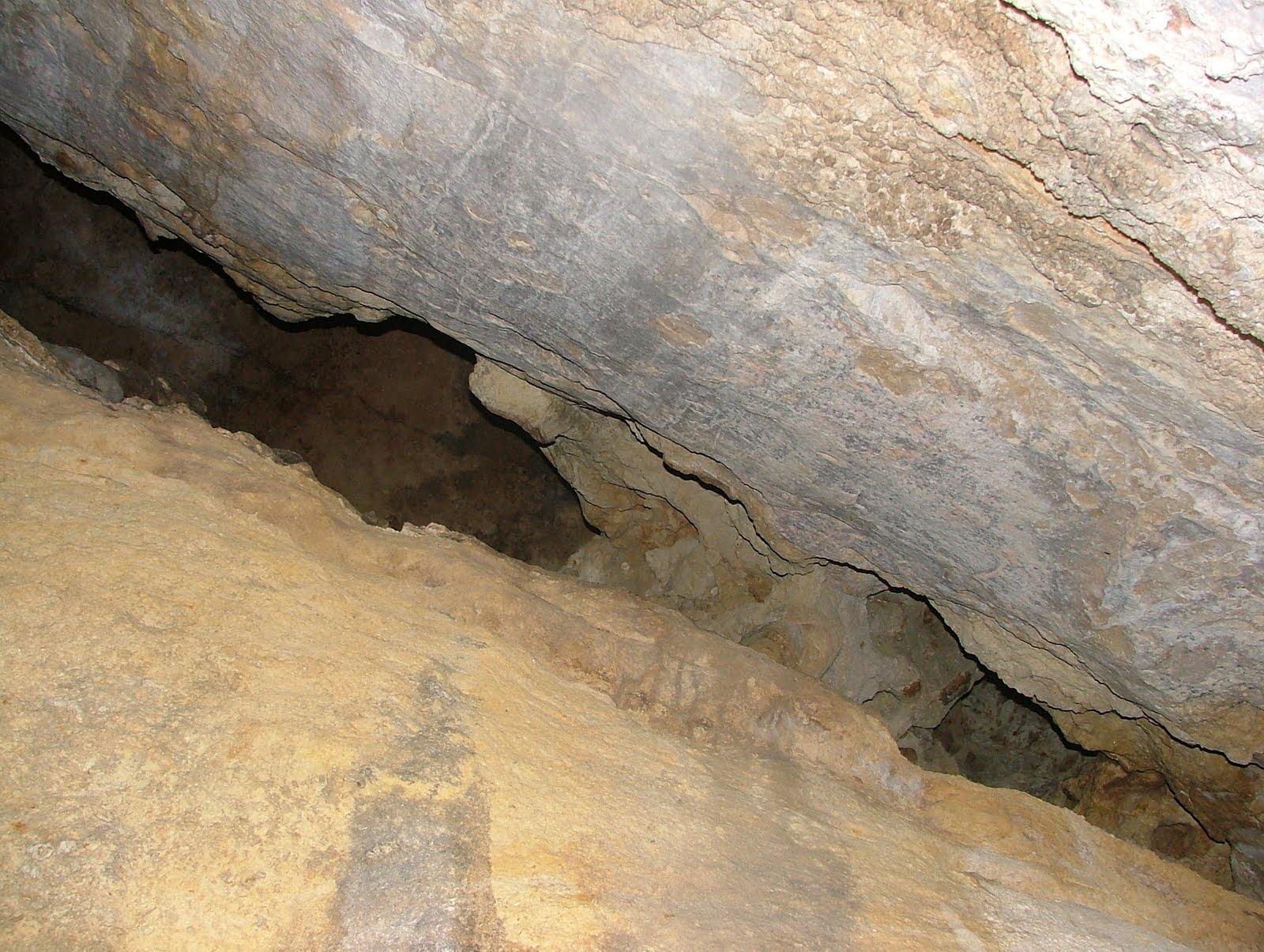
The locality where this tragic tale is supposed to have taken place is, fittingly, called Għar Ħassan (Ħassan's Cave). It lies between Bengħisa and Ħal-Far, punctuating the Lower Coralline Limestone cliffs making up most of the area. Like many other caves in the Maltese Islands it is a phreatic tube formed by the dissolution of limestone in water, and this is very evident in the smooth appearance of the cave walls.


Għar Ħassan consists of a central large chamber, the accessible part of which measures about 60m. Two main paths intersect with the main one at about 20m into the cave; the one to the east (above) leads to another opening in the cliff-face while the one to the right narrows down, eventually becoming inaccessible. Some parts of the main tube are perennially wet and mainly soft calcite deposits can be seen in several places on the walls of the cave. Clayey soil, consisting of the insoluble components of limestone, covers the entire floor of the cave and is sometimes cemented in place by calcite from hard water dripping from the ceiling. Soil has prevented stalagmites from forming over the limestone floor.


A fault running along the main chamber, quite visible on the roof of the cave (above), probably contributed to to the formation of the cave by fracturing and therefore making the usually firm Lower Coralline Limestone far less resistant to water flow.

Monday, May 31, 2010

Sharks in Malta Part I - 'L-Ilsna ta' San Pawl'

The Sicilian Agostino Scilla was one of the first Europeans (together with Nicholas Steno in Denmark) to systematically study fossils and extract information about them empirically, as opposed to his contemporaries' tendency to attribute fossils to supernatural forces or a slew of mythical creatures.

Frontispiece of Agostino Scilla's 'La Vana Speculazione', 1670 - note the variety of fossils on the lower right

Both Scilla and Steno arrived to conclusions that were beginning to shape the science of geology as it is known today, in particular the then-controversial notion that fossils are derived from once-living organisms.

Interestingly, some of the fossils which both chose to illustrate in their works were obtained from Malta. These fossils are the famous glossopetrae (tongue stones), or, more accurately, fossil shark teeth, which during the Medieval, Renaissance and Baroque periods were considered to be a miraculous cure for a variety of ailments (Zammit Maempel, 1975; 1989). Malta was the centre of a lucrative business in these shark teeth and it is not hard to see how specimens could have come in Scilla and Steno's possession.

Carcharocles megalodon (Agassiz, 1843) teeth from the C2 Phosphorite Conglomerate, Malta

Most of these glossopetrae belong to the extinct Carcharocles megalodon (Agassiz, 1843), one of the largest fish ever to exist on Earth. An approximation of its size (in grey and red) compared to the modern (and morphologically similar) great white shark, Carcharodon carcharias (L., 1758) (in green) can be seen below.


The local name for these particular fossils is 'Ilsien San Pawl' (= St. Paul's Tongue) due to the belief that they formed inside the rocks while St. Paul was shipwrecked on Malta in the year 60 A. D. (Acts of the Apostles, 28: 2-7). During this episode, St. Paul shrugged off a snake which attacked him and threw it into an open fire, symbolically ridding the islands of poisonous 'vermin'.

'St. Paul's Shipwreck', by Stefano Erardi, 1683 - note the snake falling out of the main figure's hands into the fire

Carcharocles teeth from the collection of Sir Hans Sloane are also the oldest Maltese fossils in the British Museum (cf. Galea Bonavia, 2003).

References:

Galea Bonavia, C., 2003. Carcharocles megalodon (Agassiz) (Lamnidae: Neoselachae): A historical note. The Central Mediterranean Naturalist, 4 (1): 105.

Scilla, A., 1670. La vana speculazione disingannata dal senso: lettera responsiva circa i corpi marini, che petrificati si trovano in varii luoghi terrestri. Napoli: Colicchia.

Sloane, H., undated. Se la Virtu’ alessifarmaca della Terra, Glossopetre conchiti, Achini ed altre pietre figurate che si cavano dalle Rocche di Malta, sia innata o Miraculosa. Unpublished manuscript, Sloane Collection – British Library MS no. 763.

Zammit Maempel, G., 1975. Fossil sharks' teeth: a medieval safeguard against poisoning. Melita Historica, 6: 391-406.

Zammit Maempel, G., 1989. The Folklore of Maltese fossils. Papers in Mediterranean Social Studies, 1: 1-29.

Monday, January 5, 2009

Introduction Part 1: The stratigraphy of the Maltese Islands

The exposed sedimentary rocks of the Maltese Islands date back from the late Oligocene, in the Chattian period, to the late Miocene, in the Messinian period. Strata as old as the Cretaceous are present beneath the oldest exposed layers, evidence for these was obtained through examination of fossilized spores (Pedley et al., 1976).

The first Oligocene stratum exposed in Malta is the Lower Coralline Limestone (LCL). This rock is composed mainly of rhodophytes with occasional coral horizons. The predominant rhodophyte genera are Lithothamnion and Archaeolithothamnion, both of which still exist. Since these require light for autotrophic processes, the environment was probably largely shallow water with calm conditions. In some areas where this layer is exposed, gigantic foraminifers such as Heterostegina and Lepidocyclina are preserved. The top of the stratum consists of the so-called Scutella bed (Spratt, 1843), which is composed of tests of the burrowing echinoid Scutella subrotunda. A phosphorite layer (C0) is also present in some areas (Gatt, 2005).

The stratum immediately above the LCL may date from the late Oligocene (Janssen, 2004). This layer is the Lower Globigerina Limestone (LGL), which marks a deepening of the sea-level since it is composed of mainly of planktonic foraminifera, which require a deep water column for such large populations to arise. Other deep-sea species such as the endemic echinoid Coelopleurus melitensis also occur (Zammit-Maempel, 1969).The LGL is succeeded by the similar but paler Middle Globigerina Limestone (MGL), which does not contain many fossils where exposed. Finally, the Upper Globigerina Limestone (UGL) caps the deep-sea limestone unit. The C1 phosphorite layer divides the LGL and MGL while the C2 phosphorite layer divides the MGL and the UGL. Phosphorite horizons represent a slowing-down in the deposition rate of sediments and a welling of nutrients from deeper areas of the Mediterranean. Several fossils, mostly of holoplanktonic molluscs and echinoderms, as well as teeth of Chondrichthyes, are frequent.

The Blue Clay Formation (BCF) succeeds the UGL. This still shows a deep-sea deposition environment, but instead of carbonate particles, there is a shift towards clayey minerals probably derived from volcanic detritus in a nearby area, creating a muddy area. The BCF contains limonite (iron compound) nodules, and fossils found in this layer are frequently composed of the same mineral.

The Greensand Formation (GF) lies directly above the BCF. This thin layer is almost entirely absent in Malta, though quite frequent in Gozo, especially in the Gelmus area where it reaches a thickness of about 11m (Pedley et al., 1976). It is lithologically a soft sandstone containing high proportions of the mineral glauconite (a complex silicate). The foraminifer Heterostegina appears again, but as another species several times smaller than that found in the LCL. Echinoids, mostly Clypeaster spp., are extremely common, if not always intact. Some authors regard the GF as part of the Upper Coralline Limestone (UCL). This marks a return to shallow water conditions and is composed of organisms similar to those in the LCL, though this time the species Mesophyllum commune is the most important and abundant coralline alga (Bosence, 1983). Some brachiopods and molluscs with algal habitats can also be found together with relatively shallow-water species such as the bivalve Lima lima. Fossilized wave impressions in some areas of the UCL exposure shows that currents were extremely strong, confirming the shallow water hypothesis.

Further sedimentary rocks of Quaternary origin, formed after the Maltese Islands had emerged from the water, are also present at some areas. The Maghlaq coast is the location of an alluvial fan formed by the delta of a large river, while Fiddien Valley in Rabat has a considerable area of lacustrine (lake-formed) tufa with pulmonate gastropod fossils (Pedley, 1980) and imprints of tracheophytes such as Laurus nobilis (Zammit-Maempel, 1977). However, the most important Quaternary deposit is that at Ghar Dalam, which shows the successive remains from the early Pleistocene fauna to the arrival of Neolithic Man in Malta (Zammit-Maempel, 1989).

Figures:

Fig. 1. Heterostegina cf. depressa from the Lower Coralline Limestone, Xghajra, Zabbar, Malta

Fig. 2. Globigerinoides ruber from the Upper Globigerina Limestone at San Lawrenz, Gozo, Malta

Fig. 3. Heterostegina costata from the Greensand Formation at Gelmus Hill, Gozo, Malta

References:

Boehme, W. & Zammit Maempel, G. (1982), Lacerta siculimelitensis sp. n. (Sauria: Lacertidae), a giant lizard from the Late Pleistocene of Malta. Amphibia-Reptilia, 3 (2-3), pp. 257-268.
Bosence, D. W. J. (1983), Coralline algae from the Miocene of Malta. Palaeontology, 26, pp. 147-173.
Gatt, P.A. (2005), Syntectonic deposition of an Oligo-Miocene phosphorite conglomerate bed in Malta. The Central Mediterranean Naturalist, 4 (2), pp. 109-119.
Janssen, A. W. (2004), Fossils from the Lower Globigerina Limestone Formation at Wardija, Gozo (Miocene, Aquitanian), with a description of some new pteropod species (Mollusca, Gastropoda). The Central Mediterranean Naturalist, 4 (1), pp. 1-33, 4 pl.
Pedley, H. M. (1980), The occurrence and sedimentology of a Pleistocene travertine in the Fiddien valley, Malta. Proceedings of the Geologists’ Association, 91, pp. 195-202.
Pedley, H. M., House, M. R., & Waugh, B. (1976), The Geology of Malta and Gozo. Proceedings of the Geologists’ Association, 87, pp. 325-341.
Spratt, T. A. B. (1843), On the Geology of the Maltese Islands. Proceedings of the Geological Society, 4 (2:97) pp. 225-230.
Zammit Maempel, G. (1969), A New Species of Coelopleurus (Echinoidea) from the Miocene of Malta. Palaeontology, 12 (1), pp. 42-47, 6 pl.
Zammit Maempel, G. (1977), An Outline of Maltese Geology. pp. 1-44, Progress Press, Malta.
Zammit Maempel, G. (1989), Ghar Dalam – Cave and Deposits. pp. 1-74, PEG, Malta.