Showing posts with label reptilia. Show all posts

Monday, October 3, 2011

Into the forests of Liberec

Along a stream, dewdrops on a delicate horsetail (Equisetum sp.) capture sunlight, scattering it into a miniature forest buzzing with insect life, amongst which is the common yet striking Pyrrhocoris apterus (Linnaeus, 1758). This heteropteran frequently shows aggregating behaviour and is found large populations, here photographed on the bark of the Czech national tree Tilia cordata Mill.


Equisetum sp., Liberec, Czech Republic

Pyrrhocoris apterus (L., 1758) on Tilia cordata Mill.
The periphery of the forest is characterized by a colourful scatter of berry clusters belonging to rowan (Sorbus aucuparia L.) and elder (Sambucus nigra L.), both of which have been traditionally used for food and medicine by settlers all over Europe. Further into the forest, as shade and shelter become predominant, ferns and mosses cover most of the clearing and make use of the abundant leaf litter.

Sorbus aucuparia L.
Sambucus nigra L.
Ferns on the forest floor
Conifers of the area include pines (Pinus sylvestris L.) and spruce (Picea abies (L.) H.Karst), sometimes bearing evidence of food-seeking woodpeckers on their old trunks. Angiosperms such as beech (Fagus sylvatica L.) are also common, with their deceased offering an excellent resource for several fungal specimens. 

seeds of Fagus sylvatica L.
Fagus sylvatica L. compost
fungus 1
fungus 2
clues left by woodpeckers

Nymphalis antiopa (Linnaeus, 1758) and Vanessa atalanta (Linnaeus, 1758) are two beautiful and conspicuous butterflies found within the forest and elsewhere.

Nymphalis antiopa (L., 1758)
Vanessa atalanta (L., 1758)
A dead specimen of the European slow-worm Anguis fragilis Linnaeus, 1758 was a surprising find, and one of the very few vertebrates making an appearance on the day.


Anguis fragilis L., 1758

Tuesday, August 2, 2011

My first encounter with a Canarian dinosaur

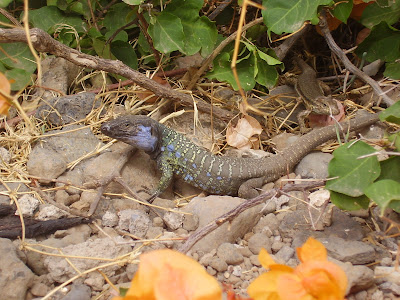
As soon as one starts travelling around Tenerife one starts becoming aware of a particular species of reptile populating much of its landscapes. The first things that struck me about this animal are its fairly large size (about 30cm in males) and its bold colouration, which are features by all means not unheard of in lizards (see here for an extinct Maltese giant lizard); however, being more accustomed to the smaller and much more agile Maltese Podarcis, I was surprised.

The lizards are also fearless and will venture very close to their human observers, especially if food is involved. They are endemic to Tenerife and belong to the species Gallotia galloti Oudart, 1839, which has differentiated into four subspecies around the same island and its neighbours. The ones in the following pictures are from the northern population of Gallotia galloti eisentrauti Bischoff, 1982 in Puerto de la Cruz, Tenerife.

It can be seen here that males are characterized by the larger size and a neon-blue throat, together with several other markings not found in females, which on the other hand are smaller and covered in brown patterns.

male specimen of Gallotia galloti eisentrauti Bischoff, 1982 basking in the sun

male Gallotia galloti eisentrauti Bischoff, 1982


female Gallotia galloti eisentrauti Bischoff, 1982 on the alert

The other subspecies are Gallotia galloti galloti (Oudart, 1839) from southern Tenerife, Gallotia galloti insulanagae Martin, 1985, from the isolated and inaccessible island northeast of Tenerife (Roque de Fuera de Anaga), and Gallotia galloti palmae (Boettger & Müller, 1914) from the island of La Palma.

The lizards are also an icon of the Guanche (aboriginal/ pre-Hispanic) culture on Tenerife, with several depictions and rock carvings still existing and on show in museums. They also ensure a steady income from tourists, their (highly non-realistic) outlines being featured on everything from ashtrays to t-shirts (though I must admit I had to buy one of the latter).


Tuesday, June 22, 2010

Gozo crocodiles


The picture above shows a fossil skull of the Miocene crocodilian Tomistoma gaudensis (Hulke, 1871) from the Globigerina Limestone of Gozo. This specimen is located at the National Museum of Natural History, Mdina, reg. no. NMNH-T11228. Another species, namely Tomistoma champsoides (Owen in Hulke, 1871) is also known to have occurred in the area now occupied by the Maltese Islands.

Reference:

Hulke, J. W., 1871. Note on some reptilian fossils from Gozo. Quarterly Journal of the Geological Society, 27 (1-2): 29-33.

Sunday, May 30, 2010

Spot the reptile

It was only after this photograph was taken and downloaded to my computer than I realized that a vertebrate could be seen sunbathing on one of the Opuntia stems. Can you spot it?

If not, here it is again, highlighted and enlarged:


The name of this reptile is Tarentola mauritanica L. 1758. The species is generally nocturnal, but that clearly hasn't stopped this individual from enjoying a breath of fresh air!

Saturday, May 1, 2010

Yet another cold-blooded encounter

The elegant and perfectly camouflaged Telescopus fallax (Fleischmann, 1831) basks in the late afternoon sun on garigue close to Baħrija, Malta.


Apart from the characteristic patches on its skin, the easiest way to distinguish this species is from its slit-like pupils, similar to those of cats, earning it the common English name of 'cat snake'. All other snake species of the Maltese islands have round pupils.

Tuesday, March 23, 2010

Another cold-blooded encounter


This beautiful reptile, from the Qbajjar area in Western Gozo, is a juvenile specimen of the Western Whip Snake, Hierophis viridiflavus (Lacépède, 1789). It shows a different colour than sexually mature adults, which are of an intense black colour (P. J. Schembri, pers. comm. III.2010).

Sunday, March 7, 2010

A cold-blooded encounter

This is the skink Chalcides ocellatus Forsskål, 1775, a circum-Mediterranean species known in Maltese as Xaħmet l-Art. This specimen is from Żejtun and is obviously still juvenile.

More information about the author of this species can be found in my older post here.